
Lorem ipsum dolor sit amet, cibo mundi ea duo, vim exerci phaedrum. There are many variations of passaThere’s been a long-running narrative that radio is on its way out.
That it’s being replaced by streaming, overtaken by podcasts, and quietly fading into the background of a world that no longer waits for scheduled programming. On the surface, it’s an easy assumption to make. When audiences can listen to anything, anytime, anywhere, the idea of tuning in at a fixed hour can feel outdated.
But that narrative misses what’s actually happening. Radio isn’t disappearing. It’s adapting … and in many ways, it’s borrowing directly from the very thing people thought would replace it.
Podcasting hasn’t killed radio. It’s reshaping it. And that shift is already underway.

From Broadcast to On-Demand Thinking
Traditional radio has always been built around timing. Shows are scheduled, segments are structured, and listeners join when they can. It’s a model that made perfect sense when options were limited and attention was more predictable. But podcasts introduced something radio couldn’t ignore: freedom.
Freedom for the listener to choose when and how they engage. Freedom for the host to go deeper, longer, and more conversational. Freedom from the constraints of airtime.
Rather than resisting that change, radio has started to absorb it. Stations are no longer thinking purely in terms of live broadcast. They’re thinking in terms of content that can live beyond the moment. Interviews are being repurposed, extended, clipped, and distributed across platforms in ways that feel far closer to podcast strategy than traditional radio scheduling.
The shift is subtle when you’re inside it, but significant when you step back. Radio is no longer just something you tune into. It’s something you return to.
Where Live Meets Long-Form
One of the most interesting developments is how radio is blending its live nature with the depth of podcasting.
Live radio still carries something powerful immediacy. A sense that what you’re hearing is happening now, in real time, with all the unpredictability that comes with it. That hasn’t lost its value. If anything, in a world of edited content, it feels more distinct.
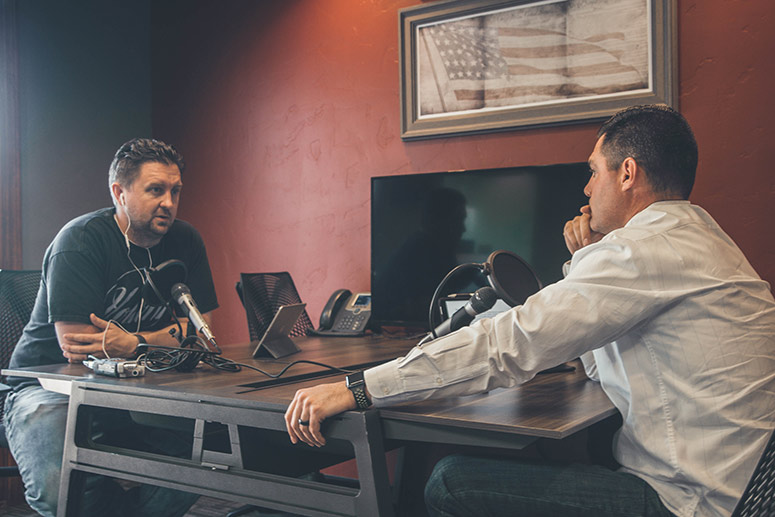
But what happens after that live moment is where things are changing. Interviews that once aired and disappeared are now being given a second life. They’re uploaded, reshaped, and reframed for audiences who may never have heard them live. The conversation doesn’t end when the segment does. It continues, often reaching a wider and more engaged audience than the original broadcast.
This is where the lines between radio and podcasting begin to blur. Because once a conversation is available on-demand, shareable, and part of a wider content ecosystem, it starts to behave like a podcast — regardless of where it originated.
A Personal Perspective: From Radio to Beyond
As a presenter on West Kent Radio, I’ve seen this shift firsthand.
What starts as a live or pre-recorded radio interview doesn’t stop there. Those conversations often move into a broader space through Beyond Unboxed, where they are repositioned and shared with a different kind of audience — one that isn’t tied to a specific time slot or geography. It’s not about duplicating content. It’s about extending it.
A ten-minute radio segment can become part of a wider narrative. It can sit alongside other conversations, be discovered by new listeners, and take on a life that goes beyond the original broadcast. The context changes. The reach changes. And importantly, the way it’s consumed changes.
Listeners who may never tune into a local radio frequency can still engage with the conversation in a way that feels relevant to them. They’re not bound by when it aired. They’re drawn by what it offers. This is where radio begins to mirror the strengths of podcasting, without losing its own identity.
The Rise of the Hybrid Host
Another shift happening in real time is the role of the presenter.
Radio hosts are no longer just broadcasters. Increasingly, they are becoming creators in their own right building personal brands, extending their voice across platforms, and engaging audiences beyond the confines of a single show.
This mirrors what we’ve already seen in podcasting, where the host is often the central draw. People don’t just listen for the guest. They listen for the perspective, the tone, the style of conversation. Figures like Steven Bartlett have demonstrated how powerful that can be. The audience doesn’t follow a platform. They follow a person. Radio is starting to recognise this. Presenters who once operated primarily within the structure of a station are now extending their presence into digital spaces, building continuity between what happens on air and what happens elsewhere. The result is a more connected, more fluid relationship with the audience.
AI Is About to Accelerate Everything
If podcasting has nudged radio into evolution, artificial intelligence is about to push it much further.
We are moving into a phase where the way content is created, distributed, and consumed will change dramatically and radio will be part of that transformation.
One of the most immediate impacts of AI is in content production. Tasks that once took hours editing audio, removing filler words, balancing sound, creating clips can now be done in minutes. This lowers the barrier for both radio stations and independent creators to produce high-quality, shareable content at scale.
But that’s just the beginning. AI is also reshaping discovery. Instead of searching for a specific show or episode, listeners will increasingly be able to ask for what they want to hear in plain language. Imagine requesting a conversation about leadership, AI, or personal transformation, and being served a curated mix of clips drawn from multiple sources — radio, podcasts, interviews all stitched together seamlessly. The platform becomes less important than the content itself. And the listener becomes even more in control.
From Stations to Streams of Meaning
As AI develops further, we’re likely to see a shift away from thinking in terms of stations altogether. Instead of tuning into a single frequency or subscribing to a specific show, listeners may engage with continuous streams of content tailored to their interests, habits, and even their mood.
Radio, in this context, becomes part of a larger ecosystem. A live interview on a local station could be:
- transcribed instantly
- broken into thematic segments
- recommended to listeners who have shown interest in similar topics
- and integrated into personalised audio feeds
The original broadcast becomes just one moment in a much longer journey.
From Stations to Streams of Meaning
As AI develops further, we’re likely to see a shift away from thinking in terms of stations altogether. Instead of tuning into a single frequency or subscribing to a specific show, listeners may engage with continuous streams of content tailored to their interests, habits, and even their mood. Radio, in this context, becomes part of a larger ecosystem.
A live interview on a local station could be:
- transcribed instantly
- broken into thematic segments
- recommended to listeners who have shown interest in similar topics
- and integrated into personalised audio feeds
The original broadcast becomes just one moment in a much longer journey.
Voice, Interaction, and the Future Listener
AI is also changing how we interact with audio. Voice interfaces are becoming more sophisticated, allowing listeners to engage with content in a more conversational way. Instead of passively consuming, they can:
- ask follow-up questions
- request related topics
- skip to specific moments within a conversation
This turns listening into something more dynamic. For radio, this presents both a challenge and an opportunity. The challenge is that passive listening is no longer enough. The opportunity is that radio content — particularly interviews and discussions is well suited to this kind of interaction. It already contains the depth and variety that AI systems can draw from and reshape.
Authenticity in an AI-Driven World
With all this change, one question becomes increasingly important is what truly remains human?
Because while AI can enhance production, distribution, and discovery, it cannot replicate genuine connection. It can simulate voices, generate scripts, even create entirely synthetic hosts. But it cannot replace the unpredictability of real conversation — the pauses, the tangents, the moments of honesty that emerge when people are not following a script.
This is where both radio and podcasting retain their value. Not in their format, but in their ability to capture something real.
The New Role of Radio
So where does this leave radio? Not as a legacy medium struggling to survive, but as a format in transition.
It still offers:
- immediacy
- locality
- and a sense of shared experience
But it is increasingly supported by:
- on-demand access
- cross-platform distribution
- and AI-driven enhancement
The future of radio is not about choosing between live broadcast and podcast-style content. In my humble opinion it becomes more about combining them.
Beyond the Frequency
What’s becoming clear is that radio is no longer confined to the frequency it broadcasts on as It exists across:
- FM and DAB
- online streams
- podcast platforms
- and social channels
And through extensions like Beyond Unboxed, conversations can move fluidly between these spaces, reaching audiences in different ways and at different times. The idea of a single point of entry is disappearing. In its place is a network of touch-points, each contributing to a larger experience.
Final Thought
Radio isn’t trying to compete with podcasts in the traditional sense. It’s learning from them. Of course those stations that aren’t learning and refuse to change are closing down. So it’s about adapting their strengths. Integrating their flexibility. Expanding beyond its original boundaries. And with AI accelerating the pace of change, that evolution is only just beginning. Because in the end, the question isn’t whether radio can survive in a podcast-driven world.
It’s whether it can continue to do what it has always done at its best — create moments of connection while embracing the tools and behaviours that define how we listen today. From where I sit, both behind the mic and beyond it, that shift isn’t coming. It’s already here.
Tune in with me on West Kent Radio:
Sundays: 08:00-10:00 GMT for the Weekend Breakfast show
Wednesdays: 19:00-20:00 GMT for the Pure 80’s
Thursdays: 20:00-22:00 GMTT for the Soul & Funk Selection with a pinch of R&B